
Happy Easter from Sicily: A Journey Through Faith, Tradition, and Timeless Beauty
- The Sicilian Wanderer

- Apr 3
- 7 min read

Easter in Sicily is not just a celebration — it is an immersive experience where spirituality, history, and identity intertwine in one of the most authentic expressions of Mediterranean culture. Across the island, ancient rituals come to life with an intensity that transcends religion, becoming a powerful narrative of community, devotion, and heritage.
From solemn processions to deeply emotional reenactments, Sicily transforms during Holy Week into a living stage where centuries-old traditions are preserved with pride. For discerning travelers and cultural explorers, this is not simply a festive period — it is a rare opportunity to witness the soul of Sicily in its most profound form.
At Great Sicily, we invite you to discover the island through its most iconic Good Friday celebrations — moments where silence speaks louder than words, and every gesture carries the weight of history.
The Most Famous Good Friday Celebrations in Sicily
Trapani – The Procession of the Mysteries

In Trapani, Good Friday becomes a monumental event that transcends time. The Processione dei Misteri is not only one of the longest religious processions in the world — lasting up to 24 hours — but also one of the most captivating and symbolically rich.
Twenty elaborate sculptural groups, known as the Misteri, represent scenes from the Passion of Christ with extraordinary artistic detail and emotional realism. Each group is entrusted to a specific guild or community, reflecting centuries-old traditions that connect craftsmanship, devotion, and identity.
The procession begins in the early afternoon and continues uninterrupted through the night and into the following day. As darkness falls, the atmosphere becomes even more evocative: the statues, illuminated by soft lights, move slowly through the crowded streets, accompanied by haunting funeral marches that echo through the city.
What makes Trapani truly unique is its rhythm — a slow, almost hypnotic pace known locally as annacata, a swaying movement of the bearers that gives the procession its distinctive, almost breathing quality. This rhythm creates a sense of continuity, as if the entire city were moving together in a shared act of devotion.
Here, the boundary between participants and spectators dissolves. The procession is not something to watch — it is something to experience, to feel, to become part of. Locals follow it for hours, sometimes for the entire duration, reinforcing a deep sense of belonging and continuity.
The Misteri of Trapani are more than a tradition; they are a living heritage, a powerful expression of Sicilian identity where faith, art, and community converge in one of the most extraordinary Easter experiences in Europe.
Enna – A Sacred Silence Above the Hills

In Enna, Easter reaches one of its most profound and spiritual expressions. Perched high in the heart of the island, this ancient city becomes the setting for what is widely considered one of the most intense and authentic Good Friday processions in all of Italy.
What defines Enna is silence — a powerful, almost overwhelming silence that transforms the entire experience into something deeply introspective. Over two thousand members of historic confraternities, some dating back centuries, take part in the procession, dressed in traditional robes and hoods that preserve rituals passed down through generations.
As they move slowly through the city, the absence of noise amplifies every detail: the rhythm of footsteps, the flicker of candlelight, the weight of history carried in every gesture. There is no theatrical excess, no need for spectacle — the emotional depth emerges naturally, rooted in faith and collective memory.
The procession culminates with the arrival of the statue of the Virgin Mary, a moment charged with emotional intensity that resonates throughout the crowd. It is not uncommon to witness silent tears, bowed heads, and a shared sense of reverence that transcends individual belief.
Enna offers something rare: an experience where time seems suspended, where tradition is not performed but lived, and where spirituality becomes tangible. For those seeking the most authentic soul of Sicilian Easter, this is a place of unparalleled depth.
Modica – Intimate Devotion and Baroque Beauty

In Modica, Easter unfolds with a quiet intensity that perfectly reflects the town’s refined baroque soul. Unlike the grand scale of other Sicilian celebrations, here the experience is more intimate, deeply emotional, and profoundly rooted in community tradition.
On Good Friday, the historic center becomes a stage of devotion, where the statues of Christ and the Madonna Addolorata are carried through narrow, golden-stone streets. The soft glow of candlelight, the echo of solemn music, and the slow rhythm of the procession create an atmosphere suspended in time — one that invites reflection and emotional connection.
What makes Modica truly unique is the closeness between participants and spectators. There is no distance, no separation — only a shared sense of belonging. Families gather, generations walk side by side, and every gesture feels personal, almost whispered rather than declared.
The baroque architecture, with its intricate facades and layered perspectives, enhances the experience, turning every corner into a visual and spiritual frame. As night falls, the interplay of light and shadow transforms the city into a living painting, where faith and beauty merge seamlessly.
In Modica, Easter is not about spectacle — it is about feeling. It is a moment of collective memory, where tradition is preserved not only through ritual, but through emotion, identity, and the quiet strength of community.
Caltanissetta – A Dramatic and Theatrical Expression

In Caltanissetta, Good Friday is transformed into one of the most powerful and visually striking religious events in Sicily. Here, faith is expressed through a deeply theatrical and symbolic language that blends devotion, artistry, and centuries-old tradition.
At the heart of the celebration are the Vare — monumental sculptural groups that depict scenes from the Passion of Christ with extraordinary emotional intensity. Each piece is rich in detail and craftsmanship, turning the procession into a moving narrative that unfolds slowly through the streets of the city.
What sets Caltanissetta apart is the presence of the historic Real Maestranza, an ancient guild whose members, dressed in elegant ceremonial attire, accompany the procession with a sense of dignity and honor. Their participation adds a unique layer of identity, linking the event not only to religious devotion but also to the city’s social and historical heritage.
As the procession advances, a profound atmosphere takes over. The rhythm is slow, almost suspended, allowing every gesture, every expression, and every symbol to resonate deeply with the crowd. The interplay of light, shadow, and movement enhances the dramatic impact, creating a moment that feels both sacred and cinematic.
More than a procession, Good Friday in Caltanissetta is a collective act of memory and identity — a powerful reminder of how tradition continues to shape the cultural soul of Sicily.
Palermo – Faith in the Heart of the Capital

In Palermo, Easter unfolds as a powerful fusion of deep spirituality, centuries-old traditions, and vibrant urban life. As the cultural and historical capital of Sicily, the city offers a rich tapestry of Good Friday processions, each rooted in its own neighborhood, church, and community identity.
During Holy Week, the historic center becomes an evocative stage where sacred rituals come to life. Ancient confraternities carry beautifully crafted statues of Christ and the Virgin Mary through narrow streets, illuminated by candlelight and accompanied by slow, emotional music. The air fills with incense, silence, and reverence, creating an atmosphere that is both intimate and profoundly moving.
What makes Palermo truly unique is the extraordinary dialogue between ritual and architecture. The city’s magnificent baroque churches — richly decorated and layered with history — serve as dramatic backdrops to these processions. As their monumental doors open and the statues emerge into the streets, a symbolic connection is created between the sacred interior and the living city outside.
Yet Palermo never loses its pulse. Between moments of solemn devotion, the city continues to breathe with energy — voices, light, and everyday life intertwine with the sacred, creating a striking contrast that defines the Palermo experience. This duality is what makes Easter here so compelling: it is both deeply spiritual and vividly human, both contemplative and alive.
For travelers seeking authenticity, Palermo offers far more than a religious celebration — it reveals the true essence of Sicily: layered, intense, and unforgettable.
San Biagio Platani – The Easter Arches of Wonder

Hidden in the heart of inland Sicily, San Biagio Platani reveals one of the island’s most extraordinary and visually captivating Easter traditions — the Archi di Pasqua.
Each year, the town is transformed into a monumental open-air installation, where entire architectural structures rise along the main street, creating a symbolic gateway between earth and the sacred. These arches are not built with conventional materials, but with elements deeply rooted in the land itself: hand-crafted bread, woven reeds, bay leaves, rosemary, almonds, citrus fruits, and grains. Every detail is assembled with meticulous care, resulting in intricate patterns, sacred symbols, and baroque-inspired compositions that blend art and devotion.
What makes this tradition truly unique is the spirit of collective creation behind it. Historically, the arches are built by two rival confraternities, each working for months in secrecy to design and construct their side of the street. This silent competition elevates the artistic level year after year, turning the village into a living masterpiece where creativity, pride, and faith intertwine.
Beyond their aesthetic beauty, the arches carry a profound symbolic meaning. They represent the passage from suffering to resurrection, from winter to spring, from death to new life. Walking beneath them is not just a visual experience — it is a ritual journey, an immersion into a space where nature, spirituality, and human craftsmanship become one.
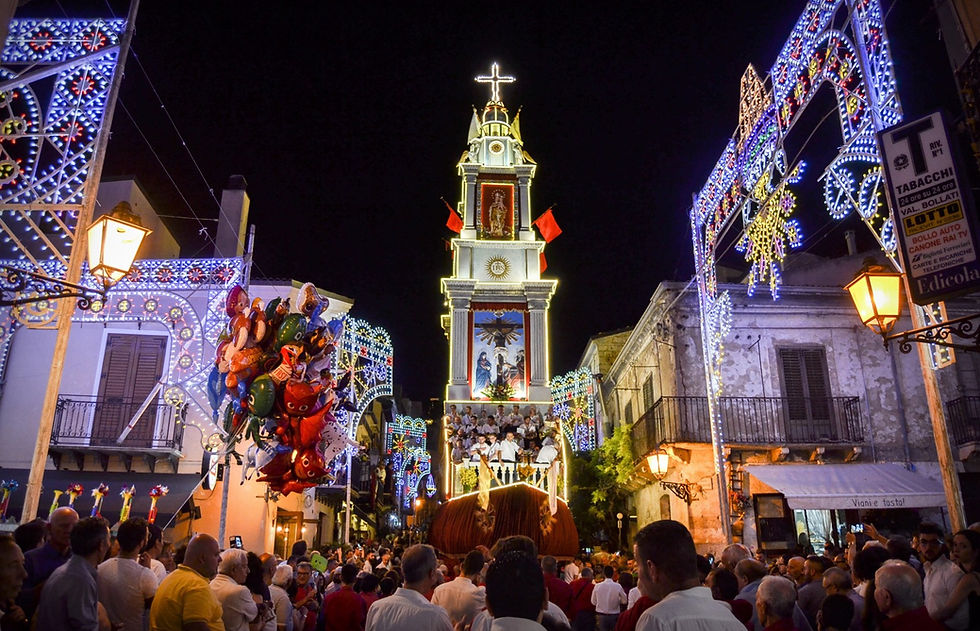
As daylight fades, the arches take on an entirely different dimension. Soft lights illuminate the natural materials, enhancing textures and colors, while the atmosphere becomes almost dreamlike. In this moment, San Biagio Platani reveals its deepest essence: a place where time slows down, traditions speak, and Easter is not simply celebrated — it is lived.
For travelers seeking authenticity and rare cultural depth, this hidden gem offers one of the most original and unforgettable Easter experiences in all of Sicily.
Beyond Celebration: A Cultural Experience of Rare Depth
What makes Easter in Sicily truly exceptional is its authenticity. These are not performances designed for tourists — they are living traditions, deeply embedded in the social and cultural fabric of each community.
For travelers seeking meaningful experiences, this is an invitation to go beyond the surface. To walk alongside locals, to feel the rhythm of ancient rituals, and to understand a land where history is not remembered — it is lived.
Happy Easter from Great Sicily
This Easter, let Sicily inspire you.
Whether you are drawn by spirituality, culture, or the timeless beauty of tradition, the island offers an experience that resonates far beyond the season. From the silent processions of Enna to the grand spectacle of Trapani, every corner of Sicily tells a story worth discovering.
Happy Easter from Great Sicily — where every journey becomes a story, and every tradition becomes a memory.



Comments