
Events in Sicily: May–June 2026 Calendar of Culture, Traditions, Nature and Timeless Experiences


Sicily in May and June reveals one of its most captivating and elegant seasons. The island slowly moves from the freshness of spring into the golden atmosphere of early summer, offering travellers a rare combination of mild weather, blooming landscapes, vibrant towns and cultural events deeply connected to the soul of the territory. It is a moment of transition, but also a moment of celebration: ancient theatres reopen to timeless performances, villages honour their patron saints with centuries-old rituals, mountain communities welcome visitors into nature, and historic centres become open-air stages for music, food, craftsmanship and local identity.
For those who wish to experience Sicily beyond the ordinary itinerary, this is one of the most rewarding times of the year. May and June allow visitors to discover the island with a slower, more authentic rhythm, before the peak of the summer season. The sea begins to shine with warmer colours, the countryside is still generous and green, and the cities preserve a refined balance between everyday life and festive energy. Every event becomes an opportunity to enter a deeper dimension of Sicily: not only to admire its beauty, but to understand its traditions, meet its communities and feel the emotional power of its heritage.
This Great Sicily May–June 2026 Events Calendar has been created as a curated guide for international travellers, travel designers, hospitality professionals and lovers of refined Mediterranean experiences. It is not intended to be a simple list of dates, but a carefully selected journey through some of the most meaningful events taking place across the island. Each appointment offers a different perspective on Sicily: its classical culture, its religious devotion, its rural excellence, its natural landscapes, its gastronomic heritage and its extraordinary ability to transform every celebration into an unforgettable experience.
From the ancient atmosphere of Catania’s Greek-Roman heritage to the spiritual intensity of Ragusa Ibla, from the mountain villages of the Madonie to the literary elegance of Taormina, Sicily presents itself as a destination where culture is not confined to museums or monuments. Here, culture is alive. It is sung in the streets, carried in processions, prepared in traditional kitchens, displayed in floral artworks, performed on historic stages and shared with visitors through sincere hospitality.
What makes these events especially valuable is their power to connect travellers with places in a more meaningful way. A festival can become the perfect reason to discover a lesser-known village. A religious celebration can reveal the emotional bond between a community and its history. A food event can open the door to local producers, ancient recipes and landscapes shaped by generations of work. A cultural festival can turn a journey into a conversation between past and present, between Sicily and the world.
Through this calendar, Great Sicily invites readers to explore the island with intention, curiosity and elegance. Every event included in the guide will be presented with practical information, tourist insights and editorial storytelling: where it takes place, why it matters, what visitors can expect, what to see nearby and how to include it within a broader Sicilian itinerary.
The result is a living travel guide for May and June 2026: a refined selection of experiences for those who want to discover Sicily not only as a destination, but as a world of traditions, beauty, encounters and timeless Mediterranean charm.
Amenanos Festival 2026

Classical Theatre in the Ancient Heart of Catania
Dates: 28 May – 4 June 2026
Location: Teatro Greco-Romano di Catania, Via Vittorio Emanuele II, 266, Catania
Category: Culture, classical theatre, archaeology, heritage experience
Best for: Cultural travellers, couples, theatre lovers, luxury itineraries, educational groups
The Amenanos Festival is one of the most evocative cultural events taking place in Sicily between May and June 2026. Hosted inside the ancient Greek-Roman Theatre of Catania, the festival brings classical drama back to one of the city’s most symbolic archaeological sites, transforming the monument into a living stage where history, myth and contemporary performance meet. The 2026 edition is scheduled from 28 May to 4 June, with performances including Medea by Seneca, Prometheus Bound by Aeschylus, and the youth section connected to the foundation legend of ancient Katane.
The setting alone makes the experience extraordinary. The Teatro Greco-Romano stands in the historic centre of Catania, hidden among the streets and buildings of the old city, just a short walk from Piazza Duomo. Its visible structure belongs largely to the Roman period, with expansions developed between the 1st and 4th centuries AD, and it could once accommodate around 7,000 spectators. The theatre rises on the southern side of the hill of Montevergine, the area traditionally linked to the ancient acropolis of Catania.
Origins and Cultural Meaning
The name Amenanos is deeply connected to Catania itself. It recalls the Amenano River, the underground watercourse that runs beneath the city and appears symbolically in some of its most iconic places. The festival was founded in 2019 by Michele Di Dio and is produced by the Associazione Culturale DIDE, with the aim of restoring centrality to ancient drama and to the Teatro Greco-Romano as one of Sicily’s great cultural stages.
The festival’s mission is not only theatrical, but also territorial. Amenanos was created to enhance a site that remained hidden for centuries beneath urban buildings and that returned to performance life only after archaeological recovery. Today, the festival gives the theatre a renewed identity: no longer simply a monument to visit, but a place where ancient words can once again resonate in front of a contemporary audience.
For Great Sicily readers, this is precisely the kind of experience that transforms a trip into a cultural journey. Attending a classical performance here means entering the layered soul of Catania: Greek memory, Roman architecture, Baroque urban life, Etna’s volcanic stone, and the invisible presence of the Amenano River all coexist in the same place.
2026 Programme Highlights
The official calendar includes:
28 May 2026, 8:00 pm Medea by Seneca, directed by Daniele Salvo.
29 May 2026, 8:00 pm Prometheus Bound by Aeschylus, directed by Daniele Salvo.
31 May 2026, 8:00 pm Prometheus Bound by Aeschylus, directed by Daniele Salvo.
1 June 2026, 8:00 pm Prometheus Bound by Aeschylus, directed by Daniele Salvo.
29–31 May 2026 Amenanos Neos Festival dei Giovani “Concetta Oliveri”, dedicated to Italian school theatre workshops.
4 June 2026, 8:30 pm Evarco – Legend of the Foundation of the City of Katane, a didactic and theatrical project involving local schools.
Why It Is Worth Experiencing
The Amenanos Festival is ideal for travellers who want to experience Sicily through culture rather than simple sightseeing. The emotional power of the event comes from the relationship between the ancient texts and the archaeological setting. Medea and Prometheus are not performed in a neutral theatre, but in a place that has witnessed centuries of transformation, destruction, rediscovery and rebirth.
For an international visitor, the event offers a rare opportunity: to attend classical theatre in an ancient Sicilian venue without leaving the atmosphere of a vibrant city. Catania adds another layer to the experience, with its lava-stone architecture, Baroque façades, street markets, historic churches, elegant restaurants and views of Mount Etna.
Tourist Information
The theatre is located at Via Vittorio Emanuele II, 266, in the historic centre of Catania. It can be reached on foot from Piazza Duomo in about 15 minutes, by AMTS city buses stopping along Via Vittorio Emanuele, or by car using nearby paid parking areas.
For visitors arriving by air, Catania Fontanarossa Airport is the main gateway. The AMTS Alibus connects the airport with the city; the ticket costs €4.00 and is valid for 90 minutes on AMTS urban lines. Tickets can be purchased on board, through the AMT Catania app, at AMT retailers or at affiliated hotels.
The archaeological site itself is open daily from 9:00 am to 7:00 pm, with last admission at 6:30 pm. Standard admission to the Teatro Romano and Odeon is listed at €8.00 full price and €4.00 reduced, although visitors attending evening performances should always check the specific event ticket conditions.
Suggested Visit Duration
For the event experience, visitors should plan at least 2.5 to 3 hours. Arriving 45–60 minutes before the performance is recommended, especially for those who want to enjoy the atmosphere of the site, take photographs, and avoid moving through the historic centre at the last minute.
For a broader cultural visit, it is worth dedicating a full afternoon to the area: begin with Piazza Duomo, the Cathedral of Sant’Agata, the Amenano Fountain and the Pescheria market area, then walk toward Via Crociferi and the Teatro Greco-Romano before attending the evening performance.
What to See Nearby
The location is excellent for exploring Catania’s historic centre. Nearby highlights include Piazza Duomo, the Cathedral of Sant’Agata, the Amenano Fountain, the Pescheria market, Via Crociferi, the Benedictine Monastery of San Nicolò l’Arena, Casa Museo Giovanni Verga, and Ursino Castle.
Travellers staying longer can combine the festival with a refined itinerary including Mount Etna, the seaside villages of Aci Castello and Aci Trezza, or a day trip to Taormina.
Where to Stay Nearby
For a comfortable and elegant stay, the best areas are the historic centre, Via Etnea, Piazza Duomo, and the streets around Via Crociferi. These locations allow visitors to reach the theatre on foot and enjoy Catania’s evening atmosphere without relying too much on transport.
For a refined urban stay, Palace Catania | UNA Esperienze is located on Via Etnea and offers a central position, rooftop dining, wellness facilities and private garage service.
For travellers who prefer boutique hospitality, Asmundo di Gisira is located in the old town near La Pescheria, the Cathedral and the Elephant Fountain, making it particularly convenient for exploring the most atmospheric part of Catania.
Another central option is Romano House, located on Via Giovanni Di Prima, suitable for visitors who want a contemporary hotel experience within walking distance of the historic centre.
Great Sicily Travel Tip

For the best experience, combine the Amenanos Festival with a slow evening in Catania. Arrive in the late afternoon, visit the area around Piazza Duomo and Via Crociferi, enjoy an early aperitivo in the historic centre, and then walk to the Teatro Greco-Romano for the performance. After the show, continue the evening with a late Sicilian dinner in the old town.
This event is particularly suitable for travellers who appreciate archaeology, classical culture, theatre, and exclusive urban experiences. It can also become the opening highlight of a broader eastern Sicily itinerary including Catania, Mount Etna, Taormina and the Riviera dei Ciclopi.
Perfetto, andiamo avanti con il secondo evento. Questo è molto interessante per Great Sicily perché ci permette di raccontare una Sicilia diversa: non solo mare e città d’arte, ma natura, borghi, lentezza, famiglie e turismo esperienziale.
Festival del Bosco 2026
Slow Travel, Nature and Authentic Experiences in the Madonie

Dates: 29 May – 7 June 2026
Location: Gratteri, Madonie Park, Province of Palermo
Category: Nature, slow tourism, outdoor experiences, family activities, local heritage
Best for: Nature lovers, families, active travellers, slow travel itineraries, cultural explorers
The Festival del Bosco 2026 will take place in Gratteri, a small and evocative village in the Madonie mountains, from 29 May to 7 June 2026. Set between the historic village and the surrounding pine forests, the event is dedicated to slow tourism, outdoor discovery, wellbeing and the authentic relationship between landscape and community. The programme is organised over two weekends: “Bosco in Movimento” from 29 to 31 May, focused on active tourism, trekking, trail running, yoga, photography walks, wild herbs and forest protection; and “Bimbi Felici tra Borgo e Bosco” from 5 to 7 June, designed for families, children and parents, with workshops, games, nature walks and the optional “Scollegati!” experience, encouraging participants to spend time away from screens.
Where It Takes Place
Gratteri is located in the province of Palermo, in the heart of the Madonie Park, one of Sicily’s most fascinating mountain territories. The village lies about 16 km from Cefalù, making it an excellent inland extension for travellers staying on the northern coast of Sicily. Visit Sicily describes Gratteri as one of the oldest and most picturesque villages of the Madonie, a place where stone streets, panoramic viewpoints, legends, medieval traces and mountain landscapes create a particularly atmospheric destination.
This position is one of the great strengths of the event. Visitors can experience the peaceful rhythm of a mountain village while remaining close to the sea, the Norman beauty of Cefalù and the wider natural heritage of the Madonie. For Great Sicily readers, Gratteri is ideal for a refined slow-travel itinerary: a place to walk, breathe, taste local products and discover a more intimate side of the island.
What the Festival Is
The Festival del Bosco is not a traditional fair in the usual sense. It is a contemporary territorial event created around the idea of reconnecting people with nature, local identity and simple experiences. Its programme brings together outdoor activities, environmental awareness, family moments and village life, turning the forest into a space for movement, learning and shared discovery.
The first weekend, Bosco in Movimento, is particularly suitable for active travellers. It includes trekking, trail running, photography walks, yoga and activities connected to wild herbs and forest conservation. The second weekend, Bimbi Felici tra Borgo e Bosco, gives the festival a more family-oriented soul, with activities for children, parents and those who want to experience nature at a slower and more playful rhythm.
Origins and Cultural Meaning
The Festival del Bosco should be understood as a modern expression of an ancient relationship: the bond between the people of the Madonie and their natural environment. The event itself is a contemporary initiative, but its inspiration comes from something much older: mountain paths, rural knowledge, the use of wild herbs, village traditions, local hospitality and the deep presence of the forest in everyday life.
The Madonie Park is especially significant in Sicily because of its biodiversity. The official park authority describes it as the richest area in Sicily for biodiversity and one of the richest in the entire Mediterranean basin. The park includes fifteen municipalities, among them Gratteri, Cefalù, Castelbuono, Collesano, Isnello, Petralia Soprana and Petralia Sottana.
In this sense, the Festival del Bosco is more than an event: it is a way of presenting the Madonie as a destination for sustainable, conscious and meaningful tourism. It allows visitors to understand that Sicily is not only a coastal island, but also a land of mountains, forests, high villages, ancient paths and communities that preserve a precious relationship with the landscape.
Why It Is Worth Experiencing
The Festival del Bosco is perfect for travellers who want to slow down and discover a more authentic Sicily. It offers the possibility of combining outdoor activities with cultural exploration, without the crowds of the most famous destinations. In late May and early June, the climate is usually ideal for walking and spending time outdoors: warm enough to enjoy the season, but still suitable for trekking and village exploration.
For families, the second weekend is especially valuable because the event is designed around children, nature and shared activities. For couples and independent travellers, the first weekend offers a more active and contemplative experience, with trails, landscapes, photography and wellness moments. For travel designers and tour operators, the festival can become the centrepiece of a boutique itinerary combining Cefalù, Gratteri, the Madonie villages and selected rural experiences.
Tourist Information
The nearest major airport is Palermo Falcone Borsellino Airport. According to Visit Gratteri’s official FAQ, the distance between Palermo Airport and Gratteri is about 80 km, with a road distance of around 101.6 km, and the fastest way to reach the village from the airport is by car, taking about 1 hour and 19 minutes. Without a car, travellers can reach Palermo Centrale, continue by train to Cefalù, and then take a bus to Gratteri; the same source also indicates the possibility of direct bus connections from Palermo to Gratteri.
For travellers already staying in Cefalù, Gratteri is a short inland excursion. The village is around 16 km from Cefalù, and the journey by car normally takes about 20 minutes, depending on traffic and mountain-road conditions.
A car is strongly recommended for international visitors who want flexibility, especially if they plan to combine the festival with other Madonie villages, nature trails or coastal stops. Comfortable walking shoes are essential, and for outdoor activities it is advisable to bring layered clothing, water, sun protection and a light jacket for the evening.
Suggested Visit Duration
For a simple visit to the festival, travellers should plan at least half a day. This allows enough time to reach Gratteri, walk through the village, take part in one activity and enjoy the atmosphere of the event.
For a richer experience, the ideal format is one full day: morning arrival, village walk, lunch or local tasting, afternoon outdoor activity and sunset from one of the panoramic viewpoints.
For travellers who want to experience the Madonie properly, the best option is one night in or near Gratteri. This allows visitors to enjoy the event without rushing, explore the surrounding trails and combine the festival with Cefalù, the Grotta Grattara area or other nearby villages.
What to See Nearby
Gratteri itself deserves time. Among the most interesting places to include in the itinerary are the Belvedere Ganci Battaglia, the Fontana della Ninfa, the Mother Church of San Michele Arcangelo, the Torre dell’Orologio, the medieval districts, the Historical Environmental Museum and the old areas connected to local legends and panoramic views. Visit Sicily also highlights the village’s relationship with the Grotta Grattàra and its identity as a “balcony on the Tyrrhenian Sea”, especially on clear days when the view can extend toward the coast and the Aeolian Islands.
Nature lovers should consider the Grotta Grattara Park, one of the symbolic excursions of the area. Visit Gratteri describes it as a must for the naturalistic and legendary itinerary of the village, reached through an uphill path in a pine forest and connected to stories, springs and local myths. Other suggested experiences include the Abbey of San Giorgio, the Valle del Berillo, Pizzo di Pilo and walking routes through the surrounding woodland.
Nearby destinations include Cefalù, ideal for sea, cathedral, restaurants and evening walks; Isnello, known for its mountain atmosphere and astronomy-related experiences; Castelbuono, one of the most elegant cultural villages in the Madonie; and Collesano, another historic centre connected to the park landscape.
Where to Stay Nearby
For travellers who want to stay directly in Gratteri, Gratteri Resort is the most suitable refined option. It is a four-star hotel located in the village, within the Madonie Park, with a wellness centre, Turkish bath, Finnish sauna and heated outdoor pool with indoor entrance. Its position makes it especially convenient for travellers attending the festival and wishing to stay immersed in the village atmosphere.
For families or longer stays, Gratteri Holiday offers houses, apartments and rooms, with solutions designed for different needs, from family accommodation to romantic or short stays. This can be a good option for travellers who prefer an independent base in the village.
For those who prefer combining nature with coastal comfort, Vallegrande Nature Resort is located inside the Madonie area near Cefalù, in a landscape of old oaks and ash trees, about 7 km from Cefalù and 3.5 km from the sea. This type of stay works well for travellers who want to experience the festival during the day and return to a more resort-style setting in the evening.
Great Sicily Travel Tip
The best way to experience the Festival del Bosco is to treat it not as a single stop, but as the heart of a slow Madonie itinerary. Start from Cefalù, move inland to Gratteri for the festival, dedicate time to the village and its panoramic viewpoints, and add at least one nature walk or guided excursion. For a more refined journey, include a night in Gratteri or nearby, allowing the landscape, silence and evening atmosphere of the mountains to become part of the experience.
This event is especially recommended for travellers who want to discover a quieter, greener and more intimate Sicily: a Sicily made of forests, paths, families, stories, local knowledge and villages suspended between mountain and sea.
Festa di San Giorgio 2026

Faith, Baroque Beauty and Living Tradition in Ragusa Ibla
Dates: 29–31 May 2026
Location: Ragusa Ibla, Province of Ragusa
Main venue: Piazza Duomo and the Cathedral of San Giorgio
Category: Religious festival, folklore, cultural heritage, Sicilian Baroque
Best for: Cultural travellers, photographers, couples, heritage lovers, slow travel itineraries
The Festa di San Giorgio Martire is one of the most intense and deeply felt celebrations in south-eastern Sicily. In 2026, the event will take place in Ragusa Ibla from 29 to 31 May, according to the tradition that places the feast on the last weekend of May or in the first days of June. The Municipality of Ragusa officially lists the 2026 celebration in Ragusa Ibla, dedicated to San Giorgio Martire, patron saint of the city of Ragusa.
Where It Takes Place
The celebration unfolds in Ragusa Ibla, the ancient and most atmospheric part of Ragusa. This historic district is famous for its stone stairways, noble palaces, narrow streets, scenic viewpoints and extraordinary late-Baroque architecture. Visit Sicily describes Ragusa as a city with “two souls”: a modern part and the ancient Baroque heart known as Ibla, where churches and palaces create one of the most elegant urban landscapes in the Val di Noto.
The heart of the festival is Piazza Duomo, dominated by the magnificent Cathedral of San Giorgio. Ragusa Welcome describes the cathedral as the symbol of the city and a masterpiece of Sicilian late-Baroque architecture, designed by Rosario Gagliardi, one of the most important Sicilian architects of the 18th century. Inside the church is preserved the image of Saint George, which is carried during the patron saint’s feast.
What the Festival Is
The Festa di San Giorgio is a religious and folkloric celebration that combines devotion, spectacle and community identity. During the feast, Ragusa Ibla fills with lights, music, processions, bells, fireworks and crowds gathering around the figure of the saint. The most famous moment is the traditional “ballata del santo”, when the statue of Saint George is carried with energy and emotion through the streets, creating one of the most powerful images of Sicilian religious devotion.
The event is not only a religious appointment. It is also an open-air cultural experience. Visitors can witness the bond between the city and its patron saint, discover the theatrical beauty of Ragusa Ibla, and experience the way Sicilian communities transform faith into collective participation, sound, movement and visual splendour.
Origins and Cultural Meaning
The cult of Saint George has ancient roots in Christian tradition, but in Ragusa Ibla it has taken on a particularly strong civic meaning. The saint is represented as a knight defeating the dragon, a symbol of courage, protection and victory over evil. In Ragusa, this image is not simply devotional: it is part of the city’s identity.
The cathedral itself is closely connected to the history of Ragusa after the devastating 1693 earthquake, which destroyed much of south-eastern Sicily. The current Duomo di San Giorgio was built in the 18th century as part of the great Baroque reconstruction of the Val di Noto. Its construction began in the 1730s and was completed around 1775, becoming one of the most celebrated religious monuments of Ragusa Ibla.
This wider Baroque context is internationally recognised. UNESCO includes Ragusa among the Late Baroque Towns of the Val di Noto, together with other south-eastern Sicilian cities rebuilt after the 1693 earthquake. These towns represent one of the highest achievements of late-Baroque urban and architectural culture in Europe.
Why It Is Worth Experiencing
For travellers, the Festa di San Giorgio offers one of the most authentic ways to understand Sicily. It is not a staged event created for tourism, but a real community celebration. The streets are alive, the cathedral becomes the spiritual centre of the city, and the entire district of Ibla turns into a theatre of devotion and beauty.
The event is especially powerful because of its setting. Ragusa Ibla is already one of the most beautiful historic centres in Sicily, but during the feast it becomes even more dramatic: the Baroque façades, the illuminated streets, the sound of the band, the movement of the procession and the emotion of the crowd create an atmosphere that is difficult to reproduce elsewhere.
For Great Sicily readers, this is a perfect event for a refined cultural itinerary in south-eastern Sicily. It can be combined with Modica, Scicli, Noto, Donnafugata Castle, Marina di Ragusa and the countryside of the Hyblean plateau.
Tourist Information
Ragusa is located in south-eastern Sicily. The most convenient airports are Comiso Airport, the closest to Ragusa, and Catania Fontanarossa Airport, the largest and most connected airport in eastern Sicily. Ragusa Welcome indicates that by car, Ragusa can be reached from Catania in about 1 hour and 30 minutes, from Syracuse in about 1 hour, and from Palermo in about 2 hours and 30 minutes, depending on the route.
For international visitors, renting a car is usually the most flexible option, especially if the plan includes other destinations in the Val di Noto. However, Ragusa can also be reached by bus from Catania, and the province is served by both Comiso and Catania airports.
During the feast, visitors should expect traffic limitations, crowded streets and possible changes to circulation in Ragusa Ibla. The Municipality of Ragusa has already announced traffic measures connected to the celebrations of San Giorgio Martire on 29, 30 and 31 May 2026, so it is advisable to check local updates close to the event dates.
Suggested Visit Duration
For the festival itself, visitors should plan at least one full day in Ragusa Ibla. This allows enough time to explore the historic centre, visit the Cathedral of San Giorgio, enjoy lunch or dinner in the old town, and attend the main festive moments in the afternoon or evening.
The ideal experience is two nights in Ragusa. This gives travellers time to enjoy the celebration without rushing, discover the quieter corners of Ibla in the morning, visit Ragusa Superiore, and include nearby destinations such as Modica or Donnafugata Castle.
For photographers and cultural travellers, the best moments are usually late afternoon, evening and night, when the lights, the Baroque architecture and the festive atmosphere create the strongest visual impact.
What to See Nearby
A visit to the Festa di San Giorgio should include time for the most beautiful places in Ragusa Ibla. The essential stops are Piazza Duomo, the Cathedral of San Giorgio, Giardino Ibleo, Santa Maria delle Scale, the panoramic viewpoints over Ibla, and the maze of small streets around the historic centre.
Nearby, travellers can visit Modica, famous for its Baroque churches and chocolate tradition; Scicli, one of the most elegant towns of the Val di Noto; Donnafugata Castle, a refined historic residence in the Ragusa countryside; and Marina di Ragusa, ideal for those who want to combine culture with the sea.
Where to Stay Nearby
For travellers who want to stay directly in Ragusa Ibla, San Giorgio Palace Hotel is one of the most convenient choices. It is a four-star hotel located in an ancient noble residence, only about 100 metres from the Duomo, with private parking reserved for guests — a very useful advantage during an event held in the historic centre.
For a more intimate boutique experience, Locanda Don Serafino offers rooms in the Baroque heart of Ragusa Ibla and private villa options in the surrounding Mediterranean landscape. Its positioning makes it suitable for travellers looking for charm, design and a strong sense of place.
For those who prefer staying in Ragusa Superiore, Relais Antica Badia is located in a restored 18th-century residence facing the Cathedral of San Giovanni Battista, with elegant interiors and a spa. This option works well for visitors who want a historic luxury atmosphere and do not mind reaching Ibla by taxi, shuttle or on foot.
For a countryside luxury stay, Eremo della Giubiliana is located a few kilometres south of Ragusa, among carob trees, dry-stone walls and the Hyblean landscape. It is ideal for travellers who want to combine the festival with relaxation, countryside, gastronomy and day trips across south-eastern Sicily.
Great Sicily Travel Tip

The best way to experience the Festa di San Giorgio is to arrive in Ragusa Ibla before sunset, when the stone façades begin to warm in the evening light and the town slowly prepares for the celebration. Spend the afternoon walking through the historic centre, visit the Cathedral of San Giorgio, stop for an aperitivo near Piazza Duomo, and then follow the rhythm of the feast as the streets fill with music, devotion and movement.
This event is especially recommended for travellers who want to feel the emotional depth of Sicily: not only its architecture, but its living traditions; not only its beauty, but the powerful connection between a city, its patron saint and its people.
Infiorata di Castelbuono 2026
Floral Art, Medieval Beauty and Slow Travel in the Heart of the Madonie
Dates: 30 May – 2 June 2026Location: Castelbuono, Madonie Park, Province of PalermoMain venue: Via Sant’Anna, at the foot of the Ventimiglia CastleCategory: Floral art, cultural festival, religious inspiration, village experience, slow tourismBest for: Cultural travellers, photographers, couples, families, art lovers, slow travel itineraries
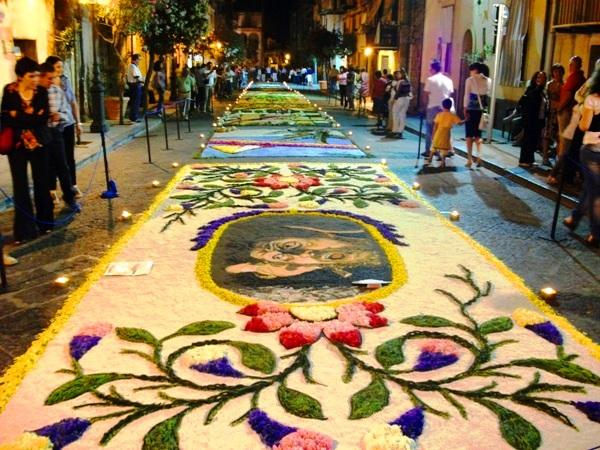
The Infiorata di Castelbuono 2026 will take place from 30 May to 2 June 2026 in one of the most charming medieval villages of northern Sicily. Now in its 18th edition, the event transforms the scenic Via Sant’Anna, located at the foot of the Ventimiglia Castle, into a long open-air carpet of flowers, colours and natural materials. The 2026 edition is promoted by the cultural association Promomadonie-Sicilia and is dedicated to the 800th anniversary of the death of Saint Francis of Assisi, creating a dialogue between art, spirituality and the natural landscape of the Madonie.
Where It Takes Place
Castelbuono is located in the Madonie Park, in the province of Palermo, not far from Cefalù and the northern Sicilian coast. It is a small medieval town with a beautifully preserved historic centre, dominated by the Ventimiglia Castle, one of the symbolic monuments of the area. Visit Sicily describes Castelbuono as a village that immediately captures visitors with its historic atmosphere, narrow streets and fairytale-like character.
The Infiorata takes place mainly along Via Sant’Anna, one of the most scenic streets in the old town. During the event, this street becomes a floral gallery created with petals, leaves, wheat ears, natural powders and other materials collected from the surrounding Madonie territory. The setting is particularly powerful because the floral artworks are not placed in an anonymous space, but inside a historic village, between stone façades, churches, local shops and the monumental presence of the castle.
What the Event Is
The Infiorata is an artistic and cultural event built around the ancient Italian tradition of creating decorative carpets with flowers and natural materials. In Castelbuono, large floral panels are arranged along the street, forming a temporary open-air exhibition that visitors can admire while walking through the historic centre.
For the 2026 edition, the official presentation states that the works will include 20 floral sketches, each measuring around 3 x 5 metres, created with fresh carnation and gerbera petals, together with other natural elements such as wheat ears, flowers, leaves, carob powder, soil and rice. These materials are used to create depth, contrast and chromatic intensity.
The programme also includes collateral activities such as historical processions, shows, concerts, tastings, workshops and guided visits to the town’s monuments and museums. This makes the Infiorata not only a visual event, but a complete village experience.
Origins and Cultural Meaning
The Castelbuono Infiorata is a relatively contemporary event, but it is rooted in older traditions of floral art, religious celebration and community participation. According to the official project description, the event is organised by Promomadonie-Sicilia, an association that has been promoting tourism, art, culture and Sicilian traditions since 2005.
Its cultural value lies in the way it brings together different generations and groups. Infioratori, local associations, schools and volunteers take part in the preparation of the floral panels, turning the event into a collective act of creativity. The result is not just decoration: it is a temporary artwork created by the community and offered to visitors as a celebration of beauty, identity and hospitality.
The 2026 theme, dedicated to Saint Francis of Assisi, gives the event an especially meaningful tone. Saint Francis is closely associated with nature, humility, peace and spiritual harmony. In Castelbuono, this theme becomes particularly appropriate because the town is surrounded by forests, mountains and landscapes that are central to the identity of the Madonie.
Why It Is Worth Experiencing
The Infiorata di Castelbuono is one of those events that allows travellers to experience Sicily in a more intimate and poetic way. It is visual, colourful and highly photogenic, but it is also deeply connected to place. The floral carpet, the medieval street, the castle, the local food, the surrounding mountains and the participation of the community all contribute to a refined and authentic experience.
For international travellers, it is an excellent opportunity to discover a side of Sicily that goes beyond beaches and major cities. Castelbuono offers the atmosphere of a mountain village, the elegance of a historic centre, the richness of local gastronomy and the possibility of combining cultural discovery with nature itineraries.
For Great Sicily readers, this event is especially suitable for a slow travel itinerary between Cefalù and the Madonie. It can be experienced as a day trip from the coast or as the centrepiece of a two-night stay dedicated to inland Sicily.
Tourist Information
Castelbuono is best reached by car, especially for travellers who want to explore the Madonie freely. The town can be accessed from the A20 Palermo–Messina motorway, using the Castelbuono or Cefalù exits, and then continuing inland toward the village. The Madonie Park authority confirms that the area is accessible from the Palermo–Messina motorway through the Cefalù and Castelbuono junctions, with local roads and signs helping visitors reach the park’s towns and routes.
From Palermo, the drive is approximately 95–100 km and usually takes a little over one hour, depending on traffic. From Cefalù, Castelbuono is much closer and works very well as a day trip into the mountains. Travellers without a car can check SAIS bus connections, but for an event with evening activities, a private transfer or rental car is more comfortable and flexible.
During the Infiorata, visitors should expect increased traffic, limited parking and a busy historic centre. It is better to arrive early, especially on Sunday 31 May, when the official programme includes the inauguration of the Infiorata in Via Sant’Anna at 7:00 pm.
Suggested Visit Duration
For a simple visit, plan at least half a day. This allows time to walk through the floral installations, visit the historic centre and enjoy a local tasting or aperitivo.
The ideal experience is one full day: arrive in the morning, visit the Ventimiglia Castle, explore the churches and museums, have lunch in the village, admire the Infiorata in the afternoon and stay until evening, when the floral carpets become even more atmospheric under the lights.
For a more refined Great Sicily itinerary, the best option is one or two nights in the area. This allows travellers to combine the Infiorata with Cefalù, the Madonie Park, local wineries, village restaurants and nature walks.
What to See Nearby
The first place to visit is the Ventimiglia Castle, built in the 14th century and now home to the Civic Museum. Visit Sicily highlights the castle, its Palatine Chapel and its connection with one of the most influential noble families in Sicilian history.
Other important stops include the Madrice Vecchia, the Madrice Nuova, the Church of San Francesco, the Francesco Minà Palumbo Naturalistic Museum, the Fountain of Venus Ciprea and the town’s historic clock tower. Castelbuono is also famous for its manna, a natural sap obtained from ash trees and used in food, cosmetics and traditional preparations.
Nearby, travellers can visit Cefalù, one of Sicily’s most elegant coastal towns; Pollina, known for panoramic views and manna production; Isnello, a quiet mountain village; and other Madonie destinations such as Petralia Soprana, Petralia Sottana, Geraci Siculo and Gangi.
Where to Stay Nearby
For travellers looking for a refined countryside stay, Abbazia Santa Anastasia is one of the strongest options near Castelbuono. It is a wine resort located in Contrada Santa Anastasia, within the Castelbuono territory, and is especially suitable for couples and travellers who want to combine the Infiorata with wine, landscape and relaxation.
For those who prefer staying directly in town, Hotel Paradiso delle Madonie is a practical choice in Castelbuono, close to the historic centre and convenient for visitors who want to experience the event without long transfers.
Another excellent strategy is to stay in Cefalù, especially for travellers who want to combine the Infiorata with the sea, the Norman cathedral, restaurants and coastal walks. From Cefalù, Castelbuono can be visited as an inland excursion, but during the event a private transfer or rental car is strongly recommended for flexibility.
Great Sicily Travel Tip

The most memorable way to experience the Infiorata is to arrive in Castelbuono before the crowds, explore the village slowly, and return to Via Sant’Anna at different moments of the day. In the morning, the floral artworks can be appreciated in natural light; in the evening, the atmosphere becomes warmer, more intimate and more theatrical.
This event is perfect for travellers who want to see Sicily through colour, craftsmanship and local identity. It can become the heart of a beautiful itinerary combining Cefalù, Castelbuono, the Madonie Park and selected food or wine experiences: a journey into one of the island’s most elegant inland landscapes.
Quisquina Cheese Festival 2026

Cheese, Rural Heritage and Sicani Mountain Flavours in Santo Stefano Quisquina
Dates: 30–31 May 2026
Location: Santo Stefano Quisquina, Province of Agrigento
Main area: Historic centre / Via Roma area
Category: Food festival, local products, rural culture, Sicani Mountains, slow travel
Best for: Food lovers, families, slow travellers, countryside itineraries, cultural explorers
The Quisquina Cheese Festival 2026, officially listed by the Municipality of Santo Stefano Quisquina as the Sagra del Formaggio, will take place on 30 and 31 May 2026. It is a gastronomic event dedicated to local dairy products, tastings and performances, designed for visitors who love traditional cuisine, local products, popular festivals and the culture of food. The official municipal programme also mentions guided tastings, taste workshops, cooking shows with chefs and meetings dedicated to cheese-making culture.
Where It Takes Place
Santo Stefano Quisquina is a mountain town in the province of Agrigento, located in the inland area of the Monti Sicani. The town rises at about 732 metres above sea level in the Magazzolo valley and is approximately 73 km from Agrigento. Its position makes it ideal for travellers who want to discover the agricultural and pastoral heart of Sicily, far from the most crowded coastal routes.
This is a territory of hills, pastures, forests, hermitages and small rural communities. For international visitors, Santo Stefano Quisquina offers a precious opportunity: to experience Sicily through its inland identity, where food is not simply something to taste, but the result of landscape, seasonality, family knowledge and local work.
What the Festival Is
The Quisquina Cheese Festival celebrates the dairy tradition of Santo Stefano Quisquina and the wider Sicani area. During the two-day event, visitors can expect tastings, food workshops, cooking demonstrations, meetings on cheese culture and moments of entertainment. Enjoy Sicilia also describes the festival as including cooking shows, tastings, guided visits, exhibitions, folkloric performances, music and entertainment.
The heart of the event is cheese, but the experience goes beyond cheese alone. It is a celebration of the local table: dairy products, rural recipes, typical products, producers, artisans and the atmosphere of a village that opens itself to visitors. For a Great Sicily itinerary, this event works beautifully as a stop for travellers interested in food culture, rural Sicily and authentic inland experiences.
Origins and Cultural Meaning
Although the festival is a contemporary event, its meaning is rooted in a much older world: the pastoral economy of the Sicani Mountains. A municipal press release for a previous edition described the Quisquina Cheese Festival as an annual event dedicated to the enhancement of the territory and its typical products, highlighting the area’s long-standing dairy tradition and the role of cheese-making as a link between economy and landscape.
The local cheese tradition is recognised beyond the festival itself. ONAF, the Italian National Organisation of Cheese Tasters, lists Formaggio di Santo Stefano di Quisquina as a Sicilian PAT product. It is described as a medium-to-long-aged cheese made mainly from sheep’s milk, sometimes with small quantities of cow’s milk, produced in the central Monti Sicani area between the provinces of Agrigento and Palermo.
This makes the festival especially interesting for travellers who want to understand Sicily through its food heritage. The cheeses tasted here are not anonymous products: they belong to a precise geography, shaped by altitude, pastures, animals, rural skills and the historical relationship between the community and its land.
Why It Is Worth Experiencing
The Quisquina Cheese Festival is ideal for travellers looking for a more intimate and genuine Sicily. It is not a polished urban event; it is a local celebration where food, people and territory remain strongly connected. Visitors can taste traditional products, meet the atmosphere of a mountain village and discover a part of Sicily that is often absent from standard itineraries.
For Great Sicily readers, the festival is particularly valuable because it can become the centre of a refined inland route. A traveller can start from Palermo or Agrigento, reach Santo Stefano Quisquina for the festival, visit the Eremo di Santa Rosalia alla Quisquina, continue to the extraordinary Teatro Andromeda, and then explore nearby villages such as Cammarata, San Giovanni Gemini, Bivona or Palazzo Adriano.
This is the Sicily of open landscapes, silence, stone villages, rural flavours and unexpected beauty.
Tourist Information
The most practical way to reach Santo Stefano Quisquina is by car. From Agrigento, the road distance is about 55 km, with an estimated driving time of around 1 hour and 10 minutes. There is also a direct bus connection from Agrigento to Santo Stefano Quisquina, with an estimated journey time of 1 hour and 15 minutes.
From Palermo, the road distance is about 82 km, with an estimated driving time of around 1 hour and 40 minutes. A direct bus connection from Santo Stefano Quisquina to Palermo is also listed, with a journey time of about 2 hours and 15 minutes.
For international travellers, a rental car remains the most comfortable solution, especially if the plan includes Teatro Andromeda, the hermitage, rural restaurants or other inland villages. During the festival, it is advisable to arrive early, wear comfortable shoes and allow extra time for parking and walking through the town centre.
Suggested Visit Duration
For the festival alone, visitors should plan at least half a day. This is enough time to enjoy the tastings, walk through the historic centre and experience the atmosphere of the event.
The ideal format is one full day: arrive in the morning, explore Santo Stefano Quisquina, enjoy the festival programme, have lunch or a tasting experience, and dedicate the afternoon to a visit to the Eremo di Santa Rosalia or Teatro Andromeda.
For a richer inland itinerary, the best option is one overnight stay in the area. This allows travellers to experience the festival without rushing and to combine gastronomy, nature and culture in a more elegant and relaxed way.
What to See Nearby
The first essential stop is the Eremo di Santa Rosalia alla Quisquina, one of the most meaningful spiritual sites in the area. According to the Province of Agrigento, the sanctuary is located in a green landscape between Monte Cammarata and Monte delle Rose, beside the cave where, according to tradition, Saint Rosalia lived for a period of her life.
Another extraordinary nearby site is the Teatro Andromeda, one of Sicily’s most unusual contemporary landmarks. Visit Sicily describes it as a work almost entirely handmade by the shepherd-sculptor Lorenzo Reina in the 1970s, built on a hill where he once grazed his flock. The Municipality places it in Contrada Rocca and lists visiting hours from 10:00 am to 1:00 pm and from 3:00 pm until sunset, with last afternoon entrance at 7:00 pm.
Other nearby places to consider include Cammarata, San Giovanni Gemini, Bivona, Palazzo Adriano and the landscapes of the Monti Sicani. These destinations are ideal for travellers interested in rural villages, panoramic roads, local food and lesser-known inland Sicily.
Where to Stay Nearby
Accommodation in Santo Stefano Quisquina is generally intimate and local, with guesthouses, B&Bs, holiday homes and agritourism-style stays rather than large luxury hotels. The Municipality confirms that the town has local hospitality structures including hotels, bed and breakfasts, agritourisms, holiday homes and campsites, advising visitors to contact individual properties for details and costs.
A practical local option is Casa Quisquina, an accommodation in Santo Stefano Quisquina described on booking platforms as offering free Wi-Fi and city views, with some rooms including mountain-view balconies.
For travellers who prefer a countryside experience, it is worth looking at agritourism properties in the surrounding Sicani area, especially near Cammarata, San Giovanni Gemini, San Biagio Platani or Palazzo Adriano. For a more structured luxury itinerary, the festival can also be planned as a day excursion from Palermo or Agrigento with a private driver.
Great Sicily Travel Tip
The best way to experience the Quisquina Cheese Festival is to treat it as a journey into the inner soul of Sicily. Arrive early, taste the local cheeses slowly, speak with producers where possible, and leave time for the places that make this territory unique: the hermitage of Santa Rosalia, the rural roads of the Sicani Mountains and the visionary landscape of Teatro Andromeda.
This event is especially recommended for travellers who want to discover Sicily through flavour, tradition and landscape. It is a perfect addition to a May–June itinerary focused on authentic food culture, mountain villages and experiences far from mass tourism.

For a richer experience, combine the Quisquina Cheese Festival with a visit to Cammarata, one of the most fascinating mountain villages in the Sicani area. Located on the slopes of Monte Cammarata, the highest peak of the Monti Sicani at 1,578 metres, the town offers a completely different image of Sicily: forests, stone alleys, mountain air, panoramic views and a strong rural identity.
Cammarata is a historic inland village with Arab and Norman roots, dominated by the remains of its medieval castle and enriched by churches, narrow streets and traditional architecture. It is also one of the gateways to the Monte Cammarata Nature Reserve, a protected area of pine woods, oaks, maples and mountain landscapes, ideal for walking, nature photography and slow exploration.
The visit works beautifully after the festival: travellers can enjoy the flavours of Santo Stefano Quisquina, then continue towards Cammarata and San Giovanni Gemini to discover the greener, quieter and more panoramic side of the Sicani Mountains. It is the perfect addition for those who want to transform a food event into a complete inland Sicily itinerary, combining cheese culture, mountain villages, nature and authentic local atmosphere.
This route is especially recommended for travellers interested in slow tourism, rural landscapes, traditional food and lesser-known Sicilian villages. It reveals a Sicily far from the usual coastal image: intimate, elevated, genuine and deeply connected to its land.
Eat Street Oliveri 2026

Sicilian Street Food, Music and Coastal Atmosphere near Tindari
Dates: 30 May – 2 June 2026
Location: Oliveri, Province of Messina
Main area: Via Roma and the town centre
Category: Street food, family event, music, coastal experience, local festival
Best for: Food lovers, families, couples, informal travellers, coastal itineraries
Eat Street Oliveri 2026 will take place from 30 May to 2 June 2026, during the long weekend of Italy’s Republic Day. The event transforms the centre of Oliveri into a Sicilian street food village, with food stands open from 5:00 pm to midnight, free entrance, music, DJ sets, entertainment and activities designed for families. The event is listed as taking place in Via Roma, Oliveri, with the official start on 30 May at 5:00 pm and closing at midnight between 2 and 3 June.
Where It Takes Place
Oliveri is a small seaside town in the province of Messina, located at the foot of Monte Tindari and overlooking the Gulf of Tindari. The municipality describes Oliveri as a town of about 2,168 inhabitants, with its most important landmarks including the ancient tuna fishery, the Laghetti di Marinello Nature Reserve and a castle of Arab origin.
This location gives the event a very attractive travel dimension. Visitors are not only attending a food festival; they are entering one of the most scenic coastal areas of northern Sicily, between the sea, the Marinello lagoons, the Sanctuary of Tindari and the Aeolian Islands visible in the distance on clear days.
What the Event Is
Eat Street Oliveri is a popular open-air event dedicated to Sicilian street food and conviviality. The format is simple and highly enjoyable: visitors walk through the centre of Oliveri, taste local specialities, listen to live music or DJ sets, and enjoy the relaxed atmosphere of a coastal town at the beginning of summer. Event listings describe the programme as four days of food, fun and entertainment, with cooking shows, music, DJ sets, family areas and shared moments in the town centre.
For Great Sicily, this event works beautifully as a lighter entry in the calendar. After classical theatre, religious festivals and floral art, Eat Street Oliveri adds the flavour of everyday Sicilian pleasure: food eaten outdoors, evening walks, music in the streets, families gathering in the centre and travellers discovering a small seaside town through taste.
Origins and Cultural Meaning
Eat Street Oliveri is a contemporary event, but its meaning is strongly connected to Sicily’s long tradition of eating in the street. Across the island, street food is not only fast food: it is an expression of local identity, practical creativity and popular culture. In Oliveri, this tradition meets the atmosphere of a fishing and seaside town, where food, summer evenings and social life naturally belong together.
The event also benefits from the historical and geographical identity of Oliveri. The municipality highlights the local tonnara, the Marinello reserve and the old castle as key elements of the town’s heritage. This makes the festival more than a simple food appointment: it becomes an opportunity to discover a small coastal destination with maritime roots and strong links to the wider Tindari area.
Why It Is Worth Experiencing
Eat Street Oliveri is ideal for travellers who want a relaxed and authentic evening by the sea. It is not a formal cultural event; it is a lively local experience where visitors can taste, walk, listen, meet and enjoy the rhythm of a Sicilian town before the peak of the summer season.
Its greatest strength is the combination of food and location. During the day, travellers can visit the Laghetti di Marinello, the Sanctuary of Tindari or the archaeological area. In the evening, they can return to Oliveri for street food and music. This makes the event very easy to include in a coastal itinerary between Messina, Milazzo, Patti and Tindari.
Tourist Information
Oliveri is served by the Oliveri-Tindari railway station, making it accessible by train along the Messina–Palermo railway line. From Messina Centrale, the journey to Oliveri-Tindari takes around 54–56 minutes on the fastest direct regional services. Connections toward Palermo Centrale are also available, with journey times generally longer and varying by service.
For travellers arriving by car, Oliveri is practical as part of a northern Sicily road itinerary. A rental car is especially useful for combining the event with Tindari, the Marinello lagoons, Milazzo or the Nebrodi coast. During the event, visitors should expect more people in the town centre, so arriving before sunset is recommended for easier parking and a more relaxed start to the evening.
Suggested Visit Duration
For Eat Street Oliveri itself, plan 2 to 3 hours in the evening. This is enough time to walk through the food stands, taste several specialities, enjoy the music and experience the atmosphere of the town centre.
For a more complete experience, plan a full day in the area: visit the Laghetti di Marinello or Tindari in the morning or afternoon, relax by the sea, and then spend the evening at the event. For travellers building a refined coastal itinerary, one overnight stay near Oliveri, Tindari or Patti makes the experience much more comfortable.
What to See Nearby
The essential nearby attraction is the Laghetti di Marinello Nature Reserve, one of the most distinctive landscapes on the Tyrrhenian coast of Sicily. The Sicilian Region describes the reserve as located below the Sanctuary of Tindari and known for its beautiful sea, villages and traces of ancient civilisations.
Another must-see is Tindari, a destination that combines spirituality, archaeology and panoramic beauty. Visit Sicily describes Tindari as an ancient Sicilian town with the Sanctuary of the Black Madonna, an archaeological area, ancient walls, Roman remains and a Greek-Roman theatre overlooking the sea.
For archaeology lovers, the Archaeological Park of Tindari is especially important. The official regional park page states that ancient Tyndaris was founded in 396 BC and preserves major public buildings including the Basilica and the Theatre, which could accommodate around 3,000 spectators.
Travellers can also extend the itinerary to Patti, Milazzo, Capo Milazzo, or the ferry connections toward the Aeolian Islands, especially if Oliveri is used as part of a wider northern Sicily route.
Where to Stay Nearby
For travellers who want to stay directly in Oliveri, Hotel Riviera Azzurra is one of the most practical options. The hotel is located at Via del Mare, 1, in Oliveri, and presents itself as a hotel and restaurant close to the sea, with facilities suitable for a coastal stay.
For a smaller local stay, Esperia B&B Oliveri offers rooms with veranda and private bathroom, with air conditioning, heating, minibar and flat-screen TV according to its official website.
Another good strategy is to stay in the wider Tindari, Patti or Furnari area, especially for travellers who want to combine the event with the Marinello lagoons, the archaeological park or a more relaxed coastal holiday. Booking platforms list numerous accommodations around Tindari and the Laghetti di Marinello area, so visitors can choose between B&Bs, seaside hotels, apartments and countryside stays depending on the style of the trip.
Great Sicily Travel Tip

The best way to experience Eat Street Oliveri is to turn it into a sea-and-culture day. Start with a visit to Tindari and its archaeological area, continue with the panoramic view over the Laghetti di Marinello, spend some time by the coast, and then reach Oliveri in the late afternoon for the food festival.
This event is especially recommended for travellers who want a relaxed Sicilian evening rather than a formal cultural programme. It is simple, lively and enjoyable: the kind of experience where street food, music, sea air and local life come together naturally.
Taobuk 2026

Literature, Art and Contemporary Thought in the Elegance of Taormina
Dates: 18–22 June 2026
Location: Taormina, Province of Messina
Main venues: Ancient Theatre, Palazzo Corvaja, Palazzo dei Duchi di Santo Stefano, Piazza IX Aprile and other cultural locations
Category: Literature, arts, culture, contemporary thought, international festival
Best for: Luxury travellers, cultural travellers, writers, art lovers, couples, international guests, high-end Sicilian itineraries
Taobuk – Taormina International Book Festival 2026 is one of Sicily’s most prestigious cultural events and one of the most refined appointments of the early summer season. Taking place from 18 to 22 June 2026, the festival transforms Taormina into an international stage for literature, art, dialogue and contemporary thought.
Set in one of the most iconic destinations in the Mediterranean, Taobuk brings together writers, artists, intellectuals, performers, journalists, cultural figures and international guests in a programme that goes far beyond the idea of a traditional book festival. It is a meeting point between literature and the arts, between beauty and ideas, between Sicily’s timeless charm and the most relevant conversations of the present.
Where It Takes Place
Taobuk takes place in Taormina, one of Sicily’s most elegant and internationally celebrated towns. Perched between the Ionian Sea and Mount Etna, Taormina has always been a place of inspiration for travellers, artists and writers. Its historic centre, panoramic terraces, noble palaces and archaeological heritage create a setting of rare beauty.
The festival is hosted in some of the town’s most symbolic locations, including the Ancient Theatre, Palazzo Corvaja, Palazzo dei Duchi di Santo Stefano, Piazza IX Aprile and other cultural spaces. The result is an event where the town itself becomes part of the experience. Every venue adds atmosphere, history and visual power to the programme.
The Ancient Theatre of Taormina is the most spectacular setting of all. Overlooking the sea and Mount Etna, it offers one of the most unforgettable cultural backdrops in Europe. Attending an event here means experiencing culture in a place where landscape, archaeology and Mediterranean light become part of the performance.
What the Festival Is
Taobuk is much more than a literary festival. It is a multidisciplinary cultural event where books meet cinema, music, theatre, visual arts, philosophy, journalism, science, politics and international debate.
The programme usually includes book presentations, conversations with authors, lectio magistralis, artistic performances, exhibitions, concerts, award ceremonies and public meetings. Each edition develops around a central theme, offering different interpretations through literature, art and contemporary reflection.
For travellers, Taobuk is an opportunity to experience Sicily through its most sophisticated cultural identity. It shows Taormina not only as a luxury destination, but as a place of thought, creativity and international exchange.
Origins and Cultural Meaning
Taobuk was created to renew and celebrate Taormina’s historic connection with literature, travel and the arts. For centuries, Taormina has attracted intellectuals, writers, painters, aristocrats and travellers from all over the world. Its beauty, light and dramatic position between sea and volcano made it one of the symbolic places of the Grand Tour and one of the great cultural destinations of the Mediterranean.
The festival continues this tradition in a contemporary way. It brings international voices to Sicily and places them in dialogue with the island’s landscape, history and identity. In this sense, Taobuk is not only an event held in Taormina: it is an expression of Taormina’s deepest vocation as a crossroads of cultures, languages and artistic visions.
Why It Is Worth Experiencing
Taobuk is ideal for travellers who want to discover Sicily at its most elegant and cosmopolitan. It is a festival where the beauty of the place enhances the value of the content. A literary dialogue in a historic palace, an evening event in Piazza IX Aprile or a gala at the Ancient Theatre becomes more than a cultural appointment: it becomes a complete Sicilian experience.
June is also one of the best moments to visit Taormina. The town is already vibrant with the energy of early summer, but still retains a refined atmosphere before the height of the peak season. The festival adds another layer to the visit: conversations, performances, evening events and a sophisticated international audience moving through one of the most beautiful historic centres in Sicily.
For Great Sicily readers, Taobuk is a perfect event for a high-end cultural itinerary. It combines luxury hospitality, Mediterranean scenery, intellectual depth and the timeless elegance of Taormina.
Tourist Information
The nearest airport is Catania Fontanarossa, the main gateway for travellers arriving in eastern Sicily. From the airport, Taormina can be reached by car, private transfer, bus or train. The journey by car usually takes about one hour, depending on traffic.
Travellers arriving by train can use Taormina-Giardini railway station, located below the historic centre. From there, taxis and local buses connect the station with the upper town. Because Taormina is built on a hillside, visitors should consider the vertical distance between the railway station, the beaches and the historic centre when planning transfers.
Once in Taormina, walking is the best way to explore the old town. The historic centre is compact, scenic and full of shops, cafés, restaurants and panoramic viewpoints. During the festival, however, the town can become busy, especially around major evening events, so it is advisable to plan movements carefully and book restaurants or transfers in advance.
Suggested Visit Duration
For travellers attending only one event, one full day in Taormina can be enough. This allows time to visit the historic centre, see the Ancient Theatre, enjoy a panoramic lunch or aperitivo, and attend an evening appointment.
The ideal Great Sicily experience is two or three nights. This gives visitors enough time to enjoy the festival without rushing, attend more than one cultural event, explore Taormina properly and include nearby experiences such as the sea, Castelmola or Mount Etna.
For guests planning to attend the main gala or evening events at the Ancient Theatre, arriving at least one day before is strongly recommended. This makes the experience more comfortable and allows time to settle into the rhythm of Taormina.
What to See Nearby
A Taobuk itinerary should begin with the Ancient Theatre, the most iconic monument in Taormina. From there, visitors can walk along Corso Umberto, the town’s elegant main street, and stop in Piazza IX Aprile, one of the most beautiful panoramic squares in Sicily.
Other essential places include Palazzo Corvaja, the Cathedral of Taormina, the Villa Comunale gardens, the medieval gates and the viewpoints overlooking the Ionian coast.
A short excursion to Castelmola is highly recommended. This small village above Taormina offers extraordinary views, quiet streets and a more intimate atmosphere. It is one of the best places to understand the dramatic landscape surrounding Taormina.
For travellers who want to include the sea, Isola Bella and Mazzarò Bay are ideal. For a broader itinerary, Taobuk can be combined with Mount Etna, Giardini Naxos, Savoca, Forza d’Agrò, the Riviera dei Ciclopi or selected wine experiences on Etna’s slopes.
Where to Stay Nearby
Taormina offers some of the most prestigious hospitality options in Sicily, making it perfect for a luxury cultural stay.
For an iconic experience, San Domenico Palace, Taormina, A Four Seasons Hotel is one of the most celebrated addresses on the island. Set in a former convent and overlooking the Ionian Sea, it is ideal for travellers seeking history, refinement and exceptional service.
For guests who want to stay close to the Ancient Theatre, Grand Hotel Timeo, A Belmond Hotel is one of the most privileged choices. Its position near the theatre makes it particularly convenient for festival appointments and evening events.
For those who prefer a seaside atmosphere, Villa Sant’Andrea, A Belmond Hotel, located in Mazzarò Bay, is perfect for combining the festival with beach time, coastal relaxation and a more resort-style experience.
Travellers looking for boutique hospitality can also find elegant small hotels, historic residences and refined guesthouses throughout the historic centre. Staying within walking distance of Corso Umberto is usually the most comfortable option during the festival.
Great Sicily Travel Tip
The best way to experience Taobuk is to treat it as a cultural escape rather than a single event. Spend the morning between the Ancient Theatre and the historic centre, enjoy lunch with a sea view, dedicate the afternoon to Castelmola or Isola Bella, and reserve the evening for one of the festival’s most atmospheric appointments.
For a high-end itinerary, Taobuk can become the centrepiece of an elegant eastern Sicily journey: Taormina, Mount Etna, Catania, the Riviera dei Ciclopi and selected wine experiences on Etna’s slopes.
This is the Sicily of ideas, beauty and international conversation: a refined expression of Mediterranean culture and one of the most elegant experiences in the Great Sicily May–June 2026 events calendar.



Comments